The Smoothness Spiral

101-smooth numbers up to 10,000

I’d recently ordered Ben Fry‘s Visualizing Data and started reading it this weekend; just a few pages in I learnt how to import data to processing and a project was born… Since New Orleans I’ve been increasingly interested in mathematical art, and whether in particular I could create something interactive. Here’s what I’ve come up with after a couple of rainy afternoons:

Update, six years later: java applets aren’t exactly trusted these days, so here’s a recreation in tableau.

So what is it? Each point represents a number up to 10,000, arranged on an Archimedean spiral, and coloured depending on its smoothness: a smooth number is one with only small prime factors. More precisely, N is B-smooth if the largest prime dividing N is at most B (so 2-smooth numbers are powers of 2; 3-smooth numbers are multiples of 2 and/or 3 only; any number shown will obviously be at worst 10,000-smooth). You can adjust the smoothness bound with the slider: in ‘gradient’ mode the brighter a point, the smoother it is; whereas in ‘threshold’ mode a point is simply plotted or not depending on whether it passes the smoothness test (the mode can be toggled by pressing space).

The least smooth numbers are the primes, and it was thinking about prime spirals that lead me in this direction: the Ulam spiral is one of the first examples of computer-aided mathematics visualisation, and I’ve taken the circular layout from its close relative, the Sacks spiral. In fact, my original plan was to use the number of prime divisors, rather than smoothness, for deciding when to plot points, with the Sacks spiral as a special case. But the pictures for larger bounds weren’t particularly interesting- 10,000 just isn’t big enough to allow much of a range of behaviour. So I switched to smoothness, and whilst that means you can’t identify the primes directly, sometimes they’re conspicuous by their absence: in the Sacks spiral there are curves with an unusually high concentration of primes, and in the smoothness spiral there are similarly ‘missing’ curves. There seem to be lots of other features too- if you’d like a closer look, here’s an enormous render of the 101-smooth numbers shown above, created using processing’s PDF mode.

Changing Perspectives

Lorenz Manifold at the Changing Perspectives Exhibition

Today’s post by Haggis the Sheep demonstrates how crochet can help understand some topologically-interesting surfaces, so I felt I should mention a similar piece of fibre art I encountered this weekend. The object on the left is a Lorenz Manifold made out of over 25,000 stitches (plus three wires), and took Bristol mathematician Hinke Osinga 85 hours to assemble. Osinga (along with Bernd Krauskopf) had been experimenting with computer visualisation of the manifold, and developed an algorithm which ‘grew’ the image from a small disc, adding layers with additional or fewer points at each step to specify the local features of the surface. This approach conveniently works just as well for wool as pixels – each row of a crochet pattern differs from the last by increasing or decreasing the number of stitches to alter the shape.

But what does it actually represent? Lorenz was one of the founders of chaos theory, discovering the ‘butterfly effect’, the way in which seemingly small changes to a system such as the weather could escalate into major differences in behaviour. The Lorenz oscillator is a set of rules for evolving the position of a point in 3-dimensional space which exhibits this chaotic nature: starting points generally find their way to the Lorentz attractor, a complex pattern that never repeats itself. However, points on the Lorenz manifold manage to avoid this trap, and instead settle at the origin, the ‘central’ point of space.

Some of Hinke and Krauskopf’s computer visualisations, their crochet of the manifold, and a rendition in steel by Benjamin Storch can be viewed for the rest of the month at The Bristol gallery, which can found down by the harbourside. They’re there as part of one of the Changing Perspectives exhibitions, which also includes work from my department’s invaluable Chrystal Cherniwchan: the photographic project Exploring the Valley, and the Mathematical Ethnographies films. As well as maths, there are exhibits inspired by scientific topics from shifting glaciers to high voltage electricity, so if you’re local, why not take a look in person? If not, well, you can get a taste from the links above, or if you’re feeling brave, grab the instructions to crochet your own Lorenz manifold!

Cyclotomic Matrices and Graphs over the ring of integers of some imaginary quadratic fields

…is the less-than-catchy title of my first paper, to appear in the Journal of Algebra. With suitable credentials it can be accessed online through ScienceDirect, otherwise there’s a preprint on the arXiv which is a close approximation. The exact details of the print edition are still being finalised; I should have a limited supply of offprints for the truly keen.

The paper covers the classification of the cyclotomic matrices/graphs for four of the six rings I considered in my thesis, but there have been some improvements to the methods. In particular, the proof that any maximal cyclotomic graph over those rings has all vertices of weighted degree four has been substantially streamlined; and there’s an explicit proof that any cyclotomic graph is contained in a maximal one. A follow-up paper proving Lehmer’s conjecture for polynomials arising from such graphs over the same rings is in preparation.

Cyclotomic Matrices and Graphs: Warwick

I’m continuing to tour my Cyclotomic Matrices and Graphs talk; today I presented it at the University of Warwick. Here’s the latest and greatest iteration of the slides, mostly unchanged except for the current state of the computer search for minimal noncyclotomics of at most ten vertices. I’d hoped to finish that this month, but the final round of growing in the most general case over the gaussian integers has progressed much slower than I expected. Given that some batches finished in a twentieth of the wall time others have consumed so far, I’m suspecting the reasons may be non-mathematical. However, I have finished the eisenstein integer case, and there are four new classes with Mahler measure less than 1.3, with representatives given in the slides.

Joint Mathematics Meetings 2011

I spent last week in New Orleans for the Joint Mathematics Meetings 2011. I’d made a rather last minute booking after noticing a couple of sessions could be useful, and hadn’t quite grasped the scale of the event. I’d normally think of 200 mathematicians as a large gathering, but the JMM had over six thousand participants and at peak more than thirty parallel sessions to choose between… the densely typed book of abstracts runs to 450 pages! Hence, as well as the content that justifies dipping into my travel budget, I was able to see a wide range of talks purely out of curiosity. So, partly for my own future convenience, and partly to give some indication of the range available, I thought I’d note down everything I attended. As that was 42 talks – plus an art exhibition and a film – this post got rather long, so the rest is beneath the cut.

Continue reading ‘Joint Mathematics Meetings 2011’ »

Talks on Cyclotomic Matrices and Graphs

I’m speaking this afternoon at the Heilbronn Seminar in Bristol: my slides are available here. This is essentially (up to permutation, and modulo errors!) the talk I gave at Royal Holloway in October, although the last few slides have been replaced with a result I’ve found since then.

I try to avoid technical details of proofs in my talks, and to make the slides intelligible even if you weren’t there, so if you just want the motivation for, or results of, my PhD work then this is probably the best place to look. For all the proofs in tedious detail, there’s my thesis itself. I’ve since come up with a much more compact proof of the results in Chapter 5, which has lead to this draft paper classifying all cyclotomic L-graphs for d=-15,-11,-7 and -2: it’s far more compact than the corresponding sections of my thesis, but perhaps at the price of readability!

If you’d just like to know more about Mahler measure and Lehmer’s problem in general, then I’d recommend this survey by Chris Smyth. For various records related to small Mahler measure, see Mossinghof’s tables.

The Bristol Chaotic Pendulum

The church of St Mary Redcliffe is a stone’s throw from my new home in Bristol, and with its soaring gothic architecture is well worth including on any visit to the city. But for a mathematical tourist there’s an extra treat: the ‘chaotic pendulum’ in the north transept.

The pendulum could be considered the symbol of predictability and regularity, serving as the essential component of timekeeping devices for hundreds of years. Yet simple modifications yield devices that instead exhibit chaotic behaviour, the typical example being the double pendulum, where one pendulum is attached to the end of another. The chaotic pendulum at St Mary’s is believed to be unique in design: water is continually pumped into the crossbeam, causing it to tip one way or the other to let it flow out again; but it’s not generally possible to predict which way it’ll go next!

It’s important to note that this isn’t because the motion is random: there are rules governing its behaviour, and if you could return the chaotic pendulum to exactly the same state as it was at the start of the video, then it’d do exactly the same again. However, in chaotic systems tiny changes can be amplified into disproportionate effects, whilst large changes might have no impact. This leads to what is known as sensitive dependence on initial conditions. Think of catching a train, where if you’re a second early then you arrive at your destination on time, but if you’re a second late you’ll have to wait for the next one, so your two second delay grows into half an hour. On the other hand, whether you arrive at the station ten minutes or ten seconds early makes no difference to when you arrive at the other end. Thus your arrival time at the destination depends on your arrival time at the station in a highly non-linear way.

So if your attempt to reset the chaotic pendulum were even slightly flawed, then the video would be useless for making predictions. Similarly, even if you could build a completely accurate mathematical model, any readings taken from the real pendulum would contain errors, and so after a while the predictions of the model would diverge from the real behaviour. Fortunately for a pure mathematician like myself it’s more interesting to build that model, capturing the essence of all chaotic pendulums, than to be able to predict the activities of a single example!

The Clifton scientific trust has this to say about the lessons that can be drawn from the chaotic pendulum:

Some people look to science for certainties on which to base their lives. Increasingly we realise our knowledge can never provide certainty, even for this simple machine. The world is a more wonderful and a more surprising place than we could have imagined.

I’d agree with their conclusion, but not for their reasons… A truly random world, for example, would be constantly surprising. What’s wonderful about ours is that seemingly complicated phenomena can be described by simple rules – complexity can emerge from the interaction of otherwise easy-to-understand parts, rather than requiring some irreducibly complex explanation (such as a creator). Whilst the existence of chaos might restrict our ability to predict, it shouldn’t discourage us from trying to explain.

Viva

Today I successfully defended my PhD thesis, Cyclotomic Matrices and Graphs. There are of course numerous corrections to be made, but I hope to have those done within the next couple of weeks and to make the final version available online. Until then, here is the abstract:

We generalise the study of cyclotomic matrices – those with all eigenvalues in the interval [-2,2] – from symmetric rational integer matrices to Hermitian matrices with entries from rings of integers of imaginary quadratic fields. As in the rational integer case, a corresponding graph-like structure is defined.

We introduce the notion of `4-cyclotomic’ matrices and graphs, prove that they are necessarily maximal cyclotomic, and classify all such objects up to equivalence. The six rings of integers for Q(√(d)) for d=-1, -2, -3, -7, -11, -15 give rise to examples not found in the rational-integer case; in four (d=-1, -2, -3, -7) we recover infinite families as well as sporadic cases.

For d=-15, -11, -7, -2, we demonstrate that a maximal cyclotomic graph is necessarily 4-cyclotomic and thus the presented classification determines all cyclotomic matrices/graphs for those fields. For the same values of d we then identify the minimal noncyclotomic graphs and determine their Mahler measures; no such graph has Mahler measure less than 1.35 unless it admits a rational-integer representative.

Exploring Cambridge

I’ve recently returned from my second ‘Young Researchers in Mathematics’ event in Cambridge, a city I never tire of visiting. At over eight hundred years old, Cambridge University has more history than some countries, so there are plenty of mathematical connections to be found as a result- I thought I’d share just a few of them today.

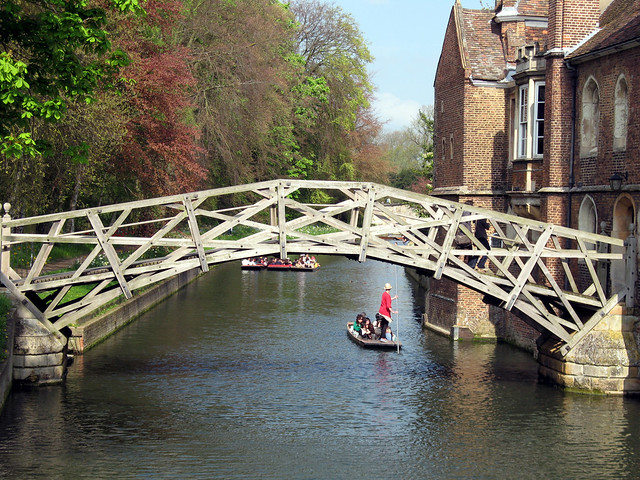
The Mathematical Bridge

As I wrote last time about a Mathematical River, it seems sensible to start with this ‘Mathematical Bridge’! Popular myth asserts that the original design was so clever that it was held together simply by gravity, a feat attributed to anyone from undergraduate students to Isaac Newton, depending on who’s telling the tale. But (the story goes) when perplexed Fellows dismantled the bridge in an attempt to understand its construction, they were unable to put it back together again without resorting to using the nuts and bolts which can be seen today. Sadly, the bolts have always been needed, although as first built (in 1749) they were invisible to those crossing the bridge – and it is at least true that it didn’t require any nails!

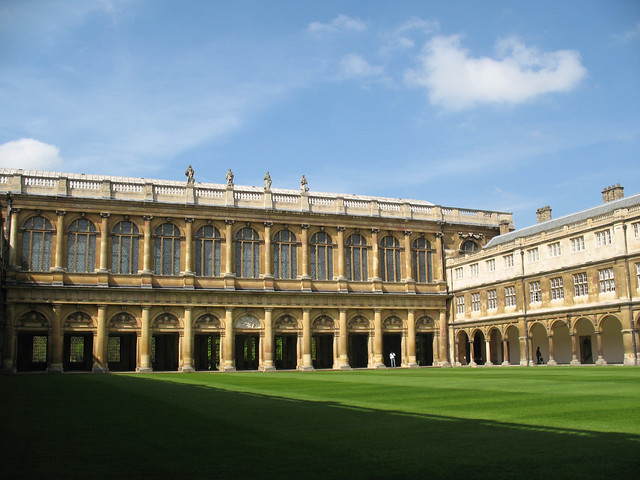
Trinity College, Cambridge

It’s unlikely, then, that Newton had a hand in the mathematical bridge, since he died twenty years before it’s construction, but that won’t dent his mathematical legacy too much. Trinity College has always had a strong mathematical reputation, admitting almost a fifth of undergraduates in the subject (of 31 colleges in total), with Newton easily their most famous predecessor. He measured the speed of sound in one of the courtyards; the library holds his annotated first edition of Principia Mathematica (and a lock of his hair!); and the tree outside the main gate is claimed to be a descendant of his famous apple tree.

CMS
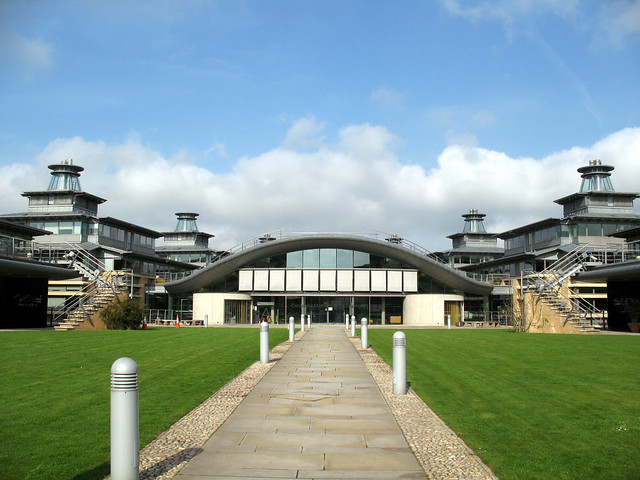
Centre for Mathematical Sciences

Until the mid-20th century, there was no central mathematics department, and instead work was done in the colleges. Today, however, research activity is concentrated at the Centre for Mathematical Sciences. It’s often joked that to find the mathematics department at a university you should look for the ugliest building, but the CMS, which opened in 2003, is a world away from 60s brutalist concrete. The ‘low energy’ design exploits natural ventilation to control the internal environment, and it’s green in a more literal sense too, with the main core having a grass roof. But it’s clearly a building meant for mathematicians, as the first things the architects were asked to design were the coffee rooms. Like the city it resides in, it’s a wonderful place to contemplate mathematics, and I hope I’ll be back again next year.

(First published on the SoSauce travel blog.)